

NSTIC (GaN) at the 84th Device Research Conference (DRC 2026)
Jun 24 2026
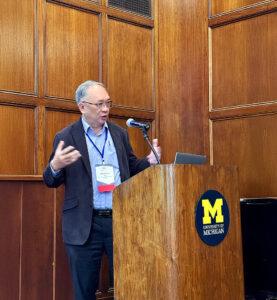
What Is the Device Research Conference?
The Device Research Conference is the world’s longest-running conference on electronic device science and technology. DRC first convened in 1942 and has brought together researchers from academia, industry, and government for over eight decades. Today, it remains a leading forum for advances in device physics, materials, fabrication, and modelling.
DRC 2026 featured plenary sessions, invited and contributed talks, short courses, and a Young Professionals Workshop. Researchers from leading institutions worldwide gathered to exchange ideas and engage with the latest developments in the field.
Speaking at DRC reflects the growing visibility of Singapore’s contributions to GaN semiconductor research on the global stage, both through NSTIC (GaN) and NTU.
Prof. Ng’s Presentations at DRC 2026
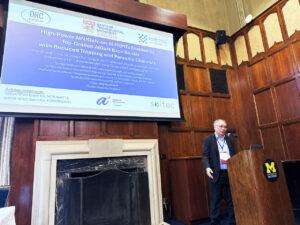
Paper: High-Power AlN/GaN-on-Si HEMTs Enabled by Top-Graded AlGaN Back Barrier with Reduced Trapping and Parasitic Channels
Prof. Ng presented the team’s latest research on AlN/GaN-on-Si high-electron-mobility transistors (HEMTs) for high-power Ku-band RF applications.
GaN-on-Si HEMTs are attractive for their lower cost and compatibility with large-wafer manufacturing. However, buffer-related trapping remains a persistent challenge. It degrades RF power performance and has historically made it difficult for GaN-on-Si to compete with GaN-on-SiC in high-power applications. AlGaN back barriers offer one way to address this, but conventional designs introduce their own complications at the interface between the back barrier and the GaN channel, namely parasitic channels and additional traps.
The work tackles this with a novel top-graded AlGaN back barrier approach. Rather than an abrupt interface, the structure uses a graded composition that smooths the transition at the channel boundary. This suppresses the parasitic channel and reduces interface-related trapping, while preserving the confinement benefits of the back barrier. The result is a device that delivers strong high-power RF performance at 18 GHz, with results that compare favourably to GaN-on-SiC and GaN-on-Sapphire technologies.
This work was supported by NRF/A*STAR under Grant No. M22L3a0112 and M23WSNG001, in collaboration with Soitec Belgium and Soitec Singapore.
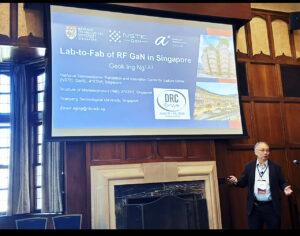
Invited Talk: Lab-to-Fab of RF GaN in Singapore
In his invited talk, Prof. Ng shared Singapore’s broader journey in RF GaN technology, tracing the path from early university research to a fully established translation and fabrication ecosystem.
NTU’s GaN-on-Si research programme has been active for over two decades. During that time, the team built up a strong foundation of technical expertise and research output, spanning device design, epitaxial growth, and process development. This long-term commitment to GaN research laid the groundwork for what NSTIC (GaN) is today.
NSTIC (GaN), which A*STAR established in 2023, aims to bridge the gap between lab research and industry-ready manufacturing. The centre focuses on translating GaN technology into scalable, accessible processes for chip designers and industry partners. Prof. Ng’s talk highlighted this mission and discussed the role Singapore can play in the global RF GaN supply chain, particularly as demand grows for high-performance semiconductor solutions in 6G telecommunications, Integrated Sensing and Communication (ISAC), and satellite applications.
The talk also touched on the longer-term outlook, noting the ongoing work to extend GaN capabilities into higher frequency bands and broaden the range of applications the technology can serve.
Looking Ahead
DRC 2026 brought together some of the most active researchers in device science from across the world. For NSTIC (GaN), it was a valuable opportunity to engage with that community, share where our work currently stands, and gain a clearer sense of where the field is heading. The discussions at DRC reinforce the direction we are pursuing, both in advancing GaN device performance and in making that technology more accessible through our fabrication and translation services.
To find out more about NSTIC (GaN) and what we do, get in touch with us. You can also find more in-depth technical papers on these advancements on our Research Publications page.