

NSTIC (GaN) at the IEEE MTT-S International Microwave Symposium (IMS 2026)
Jul 07 2026
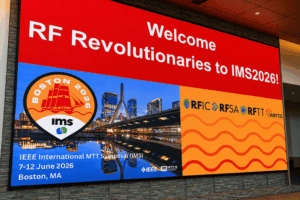
From 7 to 12 June 2026, our team attended the International Microwave Symposium 2026 (IMS 2026), organised by the IEEE MTT-S, in Boston, MA. IMS is one of the most established gatherings in the RF and microwave community, and this year’s edition brought together thousands of researchers, engineers, and industry professionals from around the world. For our team, it was an opportunity to present our latest work, engage with the broader ecosystem, and gain a first-hand look at where the industry is heading.
About the International Microwave Symposium
The International Microwave Symposium is the world’s premier annual conference for RF, microwave, and millimetre-wave technology. Organised by the IEEE Microwave Theory and Technology Society (MTT-S), IMS brings together researchers, engineers, and industry professionals from across the globe each year to share the latest advances in microwave science and technology.
IMS 2026 drew over 8,400 registered attendees from 55 countries, with more than 500 exhibiting companies and 200 education sessions. The technical programme spanned a wide range of topics, from device and circuit research to systems and emerging applications, making it one of the most comprehensive gatherings in the RF semiconductor industry.
Presenting at IMS 2026
Dr Sean Wu presented a paper in the RF GaN technical session, Tu3A: Recent Advances in GaN Technology, held on 9 June 2026. This session brought together research on the latest advances in GaN device technologies, drawing strong interest from both the academic and industry communities at the symposium.
Fully Aluminium-Based 0.25µm 20V GaN-on-Si Process with 3W/mm for FR3
The paper introduced a fully aluminium-based 0.25µm GaN-on-Si process to the broader RF ecosystem. GaN-on-Si is an attractive platform for RF applications due to its compatibility with large-wafer manufacturing and its potential for lower-cost production compared to GaN-on-SiC. However, developing a process that delivers competitive RF power performance on silicon substrates remains an active area of research.
The team’s work targets the FR3 frequency band, covering 7 to 24 GHz, which is central to next-generation 6G communications. The process achieves a power density of 3W/mm at 20V, demonstrating strong performance for a GaN-on-Si platform. The use of a fully aluminium-based process further simplifies the fabrication flow, which is an important consideration for scalability and manufacturability.
The presentation reached a broad audience of researchers and engineers from across the RF semiconductor community. It received a positive response, and several attendees offered constructive feedback. The team found this exchange valuable as it provides useful perspectives on how to further strengthen and develop its capabilities going forward.
Beyond the Technical Sessions
IMS 2026 offered much more than technical presentations. For the team, it was equally valuable as an opportunity to engage with the broader RF semiconductor ecosystem. We connected with fellow researchers and industry professionals to explore future collaborations and met with suppliers and service providers to strengthen our supply chain and broaden our offering.
The event also provided a rich environment for industry exchange. Conversations across the symposium gave us a clearer picture of the latest development trends and where the RF semiconductor market is heading. This kind of direct engagement with the ecosystem is something we find particularly useful as we continue to build and refine our capabilities at NSTIC (GaN).
Looking Ahead
IMS 2026 reinforced the importance of staying connected with the global RF community. We look forward to building on the discussions and feedback from this year’s symposium.
To find out more about NSTIC (GaN) and what we do, get in touch with us. You can also find more in-depth technical papers on these advancements on our Research Publications page.